
Basel-Landschaft 2026: Fewer downy-mildew sprays in the warm and dry season

The 2026 field trials in Basel-Landschaft show how VitiProtect 3.0 performed under two vineyard conditions during an unusually warm and dry growing season. At Liestal and Maisprach, the AI-supported spray programme reduced downy-mildew treatments compared with standard farm practice, while measured leaf infection remained low.
The trials were part of the wider VitiProtect validation programme, conducted under commercial vineyard conditions. Each site compared three plots: the grower's standard treatment programme, an untreated control and a plot managed using the VitiProtect AI model.
How the 2026 field trials worked
The trial design was the same at both sites.
In the standard plots, growers followed their usual downy-mildew treatment programme. Untreated plots provided a reference for disease pressure, while the AI plots received treatments according to the VitiProtect 3.0 model.
Disease was assessed weekly in all three plots. Local weather conditions were recorded hourly by databaum stations installed at the vineyards.
This allowed the team to compare weather measurements, predicted infection events, actual spray decisions and observed disease development at each site.
2026 was the warmest and driest season in both locations
The weather data showed a clear difference from previous seasons.
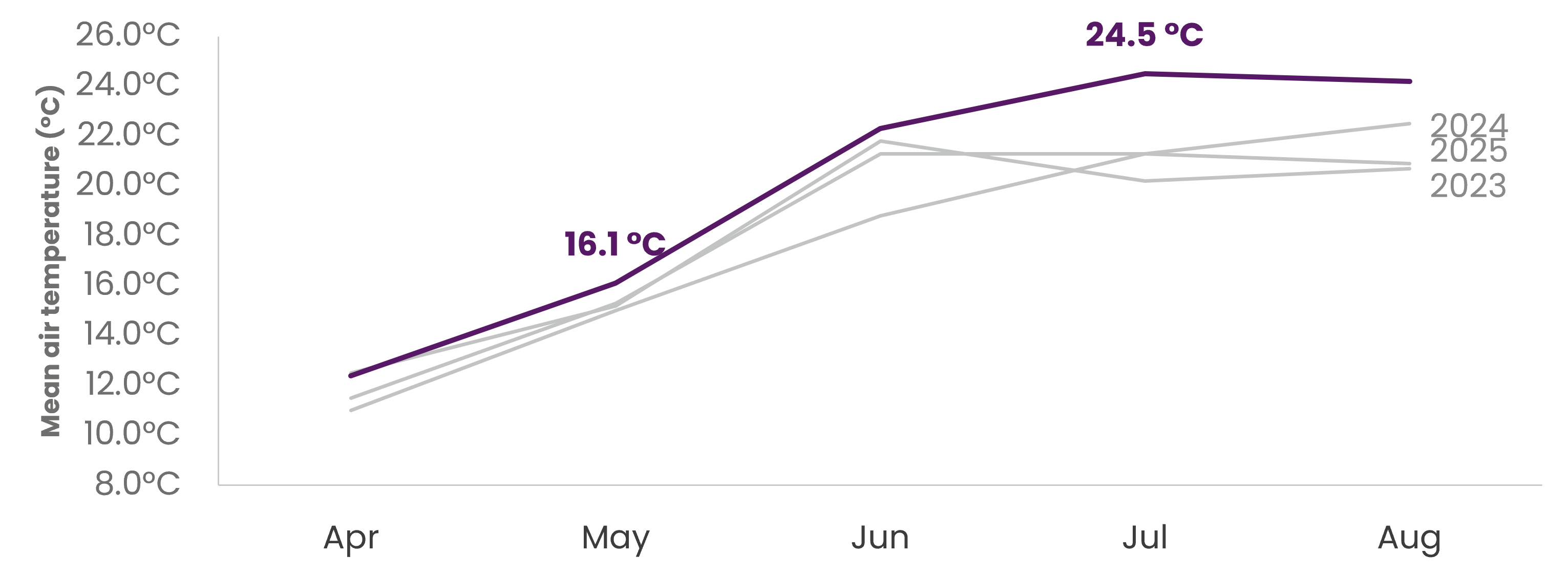
Between April and August 2026, mean air temperature reached 19.9°C at Liestal and 20.1°C at Maisprach. Both locations recorded their warmest April–August period in the four-year dataset.
July was particularly warm. The monthly mean reached 24.5°C at Liestal and 24.6°C at Maisprach, respectively 3.2°C and 3.4°C above the warmest July in the previous three years.
Days with a daily mean temperature above 25°C also increased substantially. Liestal recorded 42 such days, compared with 7–15 in 2023–2025. Maisprach recorded 43 days, compared with 8–14 in the previous three seasons.
Rainfall was exceptionally low. From April to August, the databaum stations measured only 213 mm at Liestal and 227 mm at Maisprach—less than half the rainfall recorded in the preceding seasons. July was especially dry, with just 15 mm at Liestal and 14 mm at Maisprach.
These measurements confirm that both vineyards experienced an unusually hot and dry growing season.
Local databaum stations closely matched Agrometeo
Reliable local weather measurements are essential for disease-risk modelling.
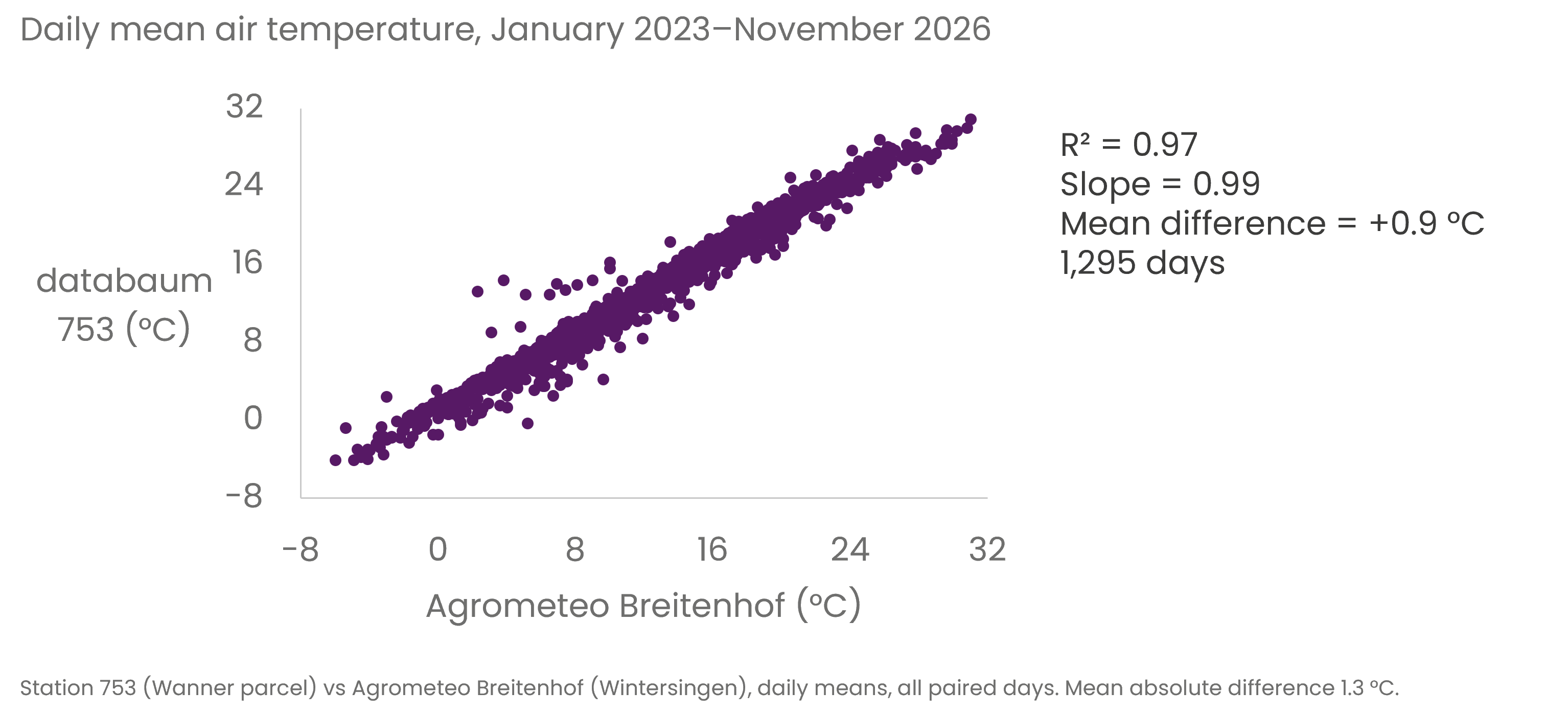
Both databaum stations showed a close relationship with the Agrometeo Breitenhof reference station in Wintersingen.
For Liestal station 753, the comparison of 1,295 paired daily observations resulted in an R² of 0.97, a regression slope of 0.99 and a mean temperature difference of +0.9°C.
For Maisprach station 687, the comparison of 1,274 paired observations also resulted in an R² of 0.97, with a slope of 0.99 and a mean difference of +0.8°C.
The mean absolute differences were 1.3°C at Liestal and 1.1°C at Maisprach.
The results show that both on-site stations closely followed the temperature patterns measured by the established Agrometeo network, while providing measurements directly at the vineyard locations.
VitiProtect 3.0 reduced spray dates at both sites
The clearest operational result was the reduction in downy-mildew spray dates.
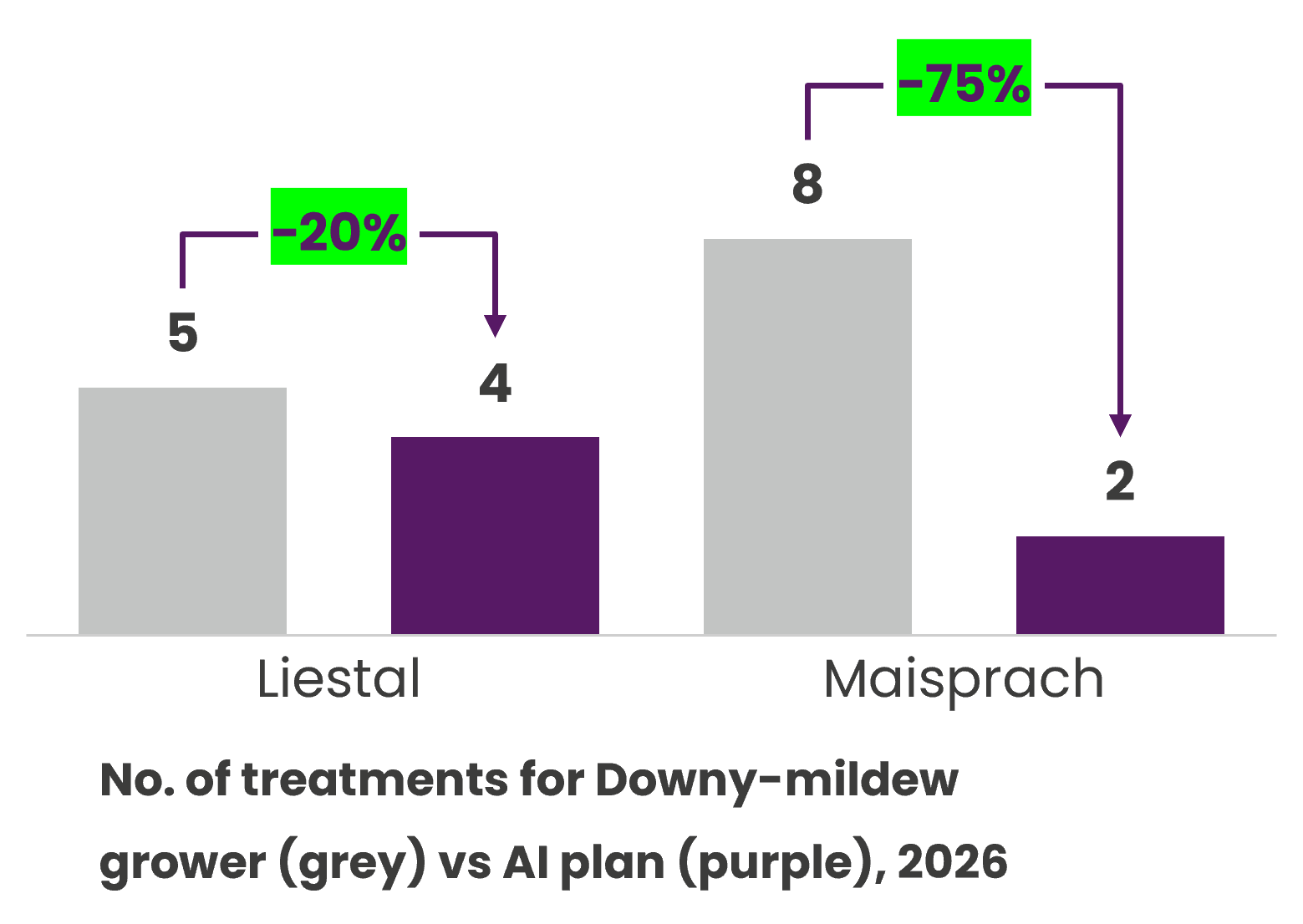
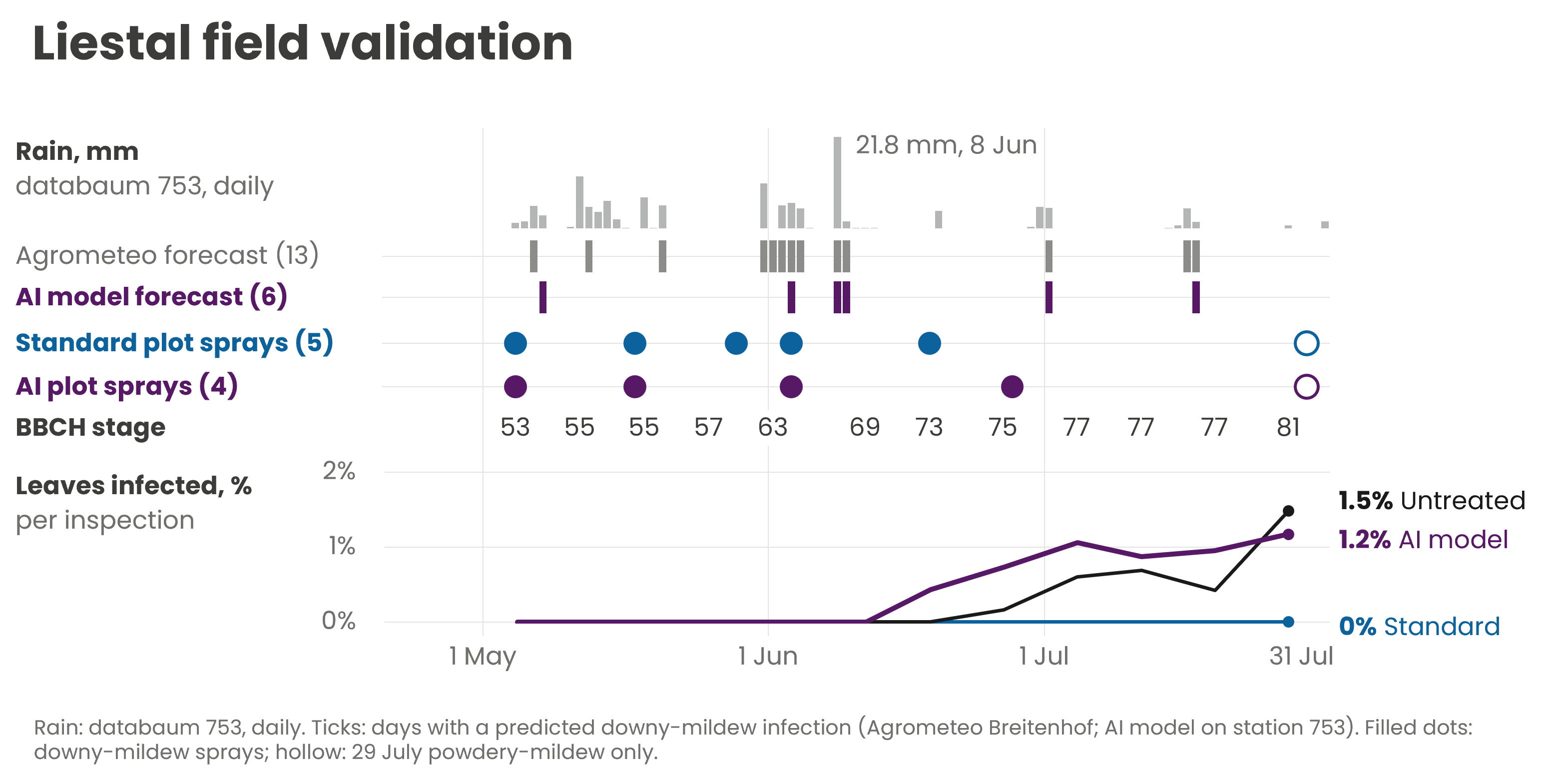
At Liestal, the AI programme required four spray dates instead of five under standard practice—a reduction of 20%.
At Maisprach, the difference was larger. The AI plot received two spray dates, on 19 May and 8 June, compared with eight dates in the standard plot, a reduction of 75%.
Across both sites, the AI programme therefore reduced the total number of downy-mildew spray dates from 13 to 6, avoiding seven applications.
The reduction was also reflected in the quantity of crop-protection products used.
At Liestal, downy-mildew product use fell from 15.9 to 12.0 units per hectare, a reduction of 25%. At Maisprach, it fell from 30.8 to 9.7 units per hectare, a reduction of 69%.
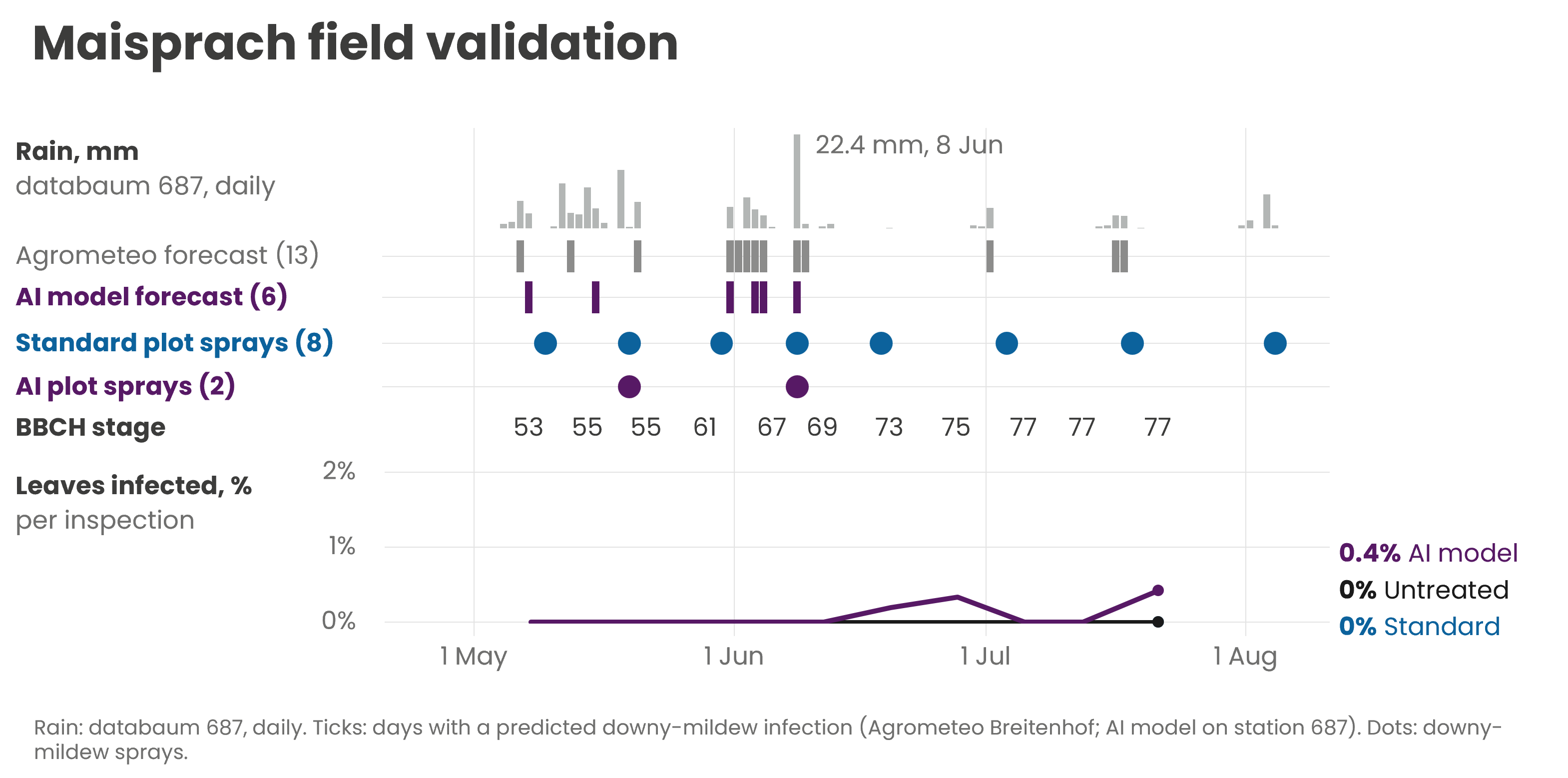
The detailed treatment records counted nine product applications in the Liestal standard plot and seven in the AI plot. At Maisprach, the corresponding figures were 19 and five. Product applications and spray dates are different measures because a single spray date can involve more than one product application.
Leaf infection remained low with fewer treatments
Fewer treatments are relevant only if disease remains adequately controlled.
In the Liestal AI plot, peak leaf infection reached 1.2%. The untreated control reached 1.5%, while no leaf infection was recorded in the standard plot.
At Maisprach, peak leaf infection in the AI plot was 0.4%. No leaf infection was recorded in either the standard or untreated plot.
These observations show that leaf infection remained low in both AI-managed plots despite the reduction in treatments.
The results must also be interpreted in the context of the season. The recorded disease levels were low at both locations, including in the untreated controls. The 2026 trials therefore provide evidence of how the model performed under the conditions observed that year, rather than demonstrating performance under every possible level of disease pressure.
No significant yield difference was reported
Growers reported no significant yield difference between the AI-managed and conventional plots.
This is a useful observation alongside the reduction in treatments. However, the report does not provide quantitative harvest measurements or establish a yield effect attributable to the AI programme.
What the Basel-Landschaft trials tell us
The 2026 Basel-Landschaft trials provide two useful findings.
First, local databaum weather stations closely matched the Agrometeo reference measurements at both sites, supporting the use of on-site weather data for vineyard-level disease-risk assessment.
Second, VitiProtect 3.0 enabled fewer downy-mildew spray dates at both vineyards. Across Liestal and Maisprach, spray dates fell from 13 to 6, while product use decreased by 25% and 69%, respectively. Peak leaf infection in the AI plots remained at or below 1.2%.
The results are encouraging, but they reflect one unusually warm and dry season with low observed disease levels. Continued validation across different seasons and disease conditions remains important.
Take-home messages
- A record-hot and dry season: Both sites recorded their warmest April–August period and less than half the rainfall of previous seasons.
- Reliable local weather data: Both databaum stations achieved an R² of 0.97 against Agrometeo Breitenhof.
- Fewer spray dates: The AI programme reduced downy-mildew spray dates by 20% at Liestal and 75% at Maisprach.
- Less product used: Downy-mildew product quantities fell by 25% and 69%, respectively.
- Low observed infection: Peak leaf infection in the AI plots remained at or below 1.2%.
- Further validation is needed: Results from a low-disease-pressure season should be tested across more challenging conditions.
The broader objective remains to use local weather measurements and disease-risk modelling to help growers make more targeted crop-protection decisions, applying treatments when vineyard conditions indicate a need.