
Orondis Ultra: Protecting Your Vineyard Against Downy Mildew
A practical guide for growers in Switzerland and the EU
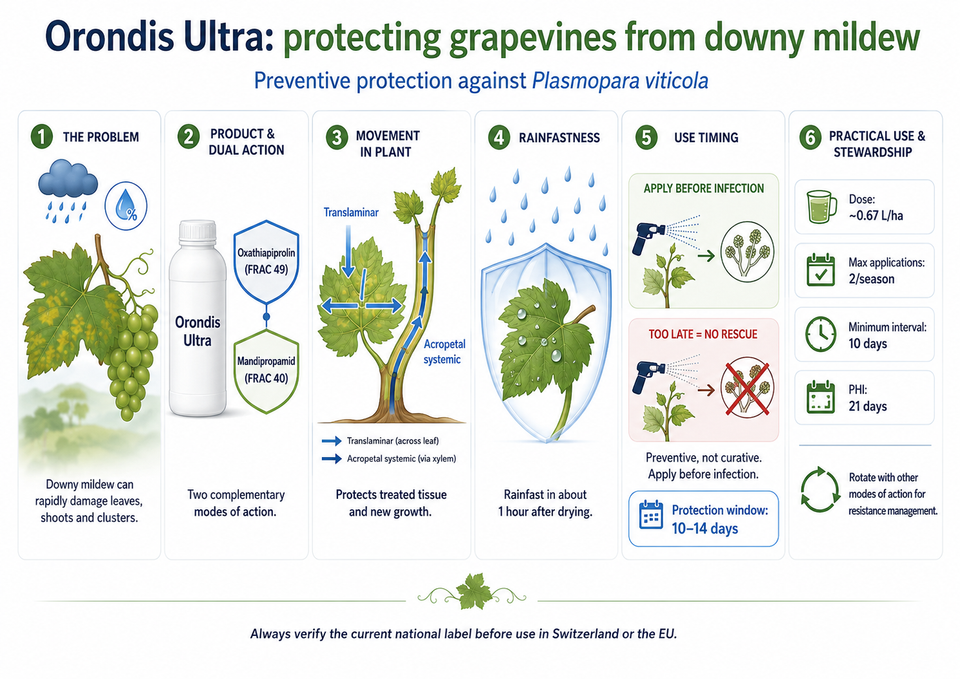
Downy mildew (Plasmopara viticola) is one of the most damaging diseases in European viticulture. In a wet spring or humid summer, a single unprotected infection cycle can devastate foliage, shoots, and clusters within days. Orondis® Ultra, developed by Syngenta, is a dedicated downy mildew specialist combining two modes of action into a single formulation.
What is in the bottle
Orondis Ultra combines two active ingredients that attack Plasmopara viticola through entirely different mechanisms:
- Oxathiapiprolin (FRAC group 49) inhibits the oxysterol-binding protein (OSBP) in oomycete cells — a novel target with no cross-resistance to any other fungicide group currently on the market.
- Mandipropamid (FRAC group 40, the active ingredient in Revus®) blocks cellulose synthesis in the oomycete cell wall, a well-proven and highly specific mechanism against downy mildew.
Together they provide two independent lines of defence against P. viticola, which matters both for efficacy and for managing resistance.
How it moves in the plant
Orondis Ultra is translaminar and acropetally systemic. After application it binds to the leaf wax, penetrates the tissue, and moves laterally across the leaf surface and upward through the xylem — the plant's water-conducting vessels — into new growth that was not even present at the time of spraying. This means it protects an actively growing canopy, not just the leaves you hit with the nozzle.
Rainfastness
Because both actives are taken up into plant tissue rather than sitting on the surface, Orondis Ultra is exceptionally rainfast. In Syngenta trials, more than 40% of the product was still recovered from grapevine leaves after 200 mm of rain falling just one hour after application. In practice, consider it rainfast within approximately one hour of the spray drying. This gives useful flexibility when applying in unpredictable spring and early summer weather.
Protective window and label terms
Orondis Ultra is a preventive and antisporulant product. Apply it ahead of expected infection periods — it is not designed as a curative rescue treatment once lesions are established. It targets the pathogen at sporulation, spore germination, and initial infection, stopping the disease cycle before it takes hold.
EU grapevine label reference terms:
| Parameter | Value |
|---|---|
| Dose | ~0.67 L/ha |
| Max. applications per season | 2 |
| Min. interval between applications | 10 days |
| Pre-harvest interval (PHI) | 21 days |
| Application window | BBCH 13–85 |
| Water volume | 100–1,000 L/ha |
The protective window per application is approximately 10–14 days, shorter under high disease pressure or rapid shoot growth.
Resistance management
With two single-site actives in the formulation, resistance management is non-negotiable. Plasmopara viticola has broken single-site chemistries before, and FRAC 49 and FRAC 40 are no exception to the risk.
- Respect the maximum of 2 applications per season.
- Rotate with products of a different mode of action — multisites such as folpet or copper, or ametoctradin-based combinations — as part of a full-season program.
- Do not use Orondis Ultra curatively under heavy inoculum pressure; applying it late into an active epidemic accelerates resistance selection.
Before you spray in Switzerland or the EU
Label conditions — dose, maximum number of applications, PHI — differ between countries and are subject to change. Before purchasing or applying, always verify the current national registration:
- Switzerland: check the official federal plant-protection-product register at psm.admin.ch. Swiss approvals for oxathiapiprolin products do not always mirror the EU label.
- EU member states: verify the active-substance status in the EU Pesticides Database and your country's national register.
The label is the legally binding document. This article is general agronomic background information, not a recommendation for use in any specific situation.
References
- Syngenta (EU label data via Nexles Europe) — grapevine dose, intervals, PHI: https://www.nexles.com/eu/syngenta-fungicide-orondis-ultra-1-liter.html
- ProAgri Media / Syngenta — rainfastness and mode-of-action data: https://www.proagrimedia.com/crops/orondis-ultra-presents-a-new-era-of-late-blight-and-downy-mildew-protection/
- Cornell University Grapes IPM — field efficacy on grapevine downy mildew: https://blogs.cornell.edu/grapes/ipm/diseases/grape-disease-control-spring-2021/
- FRAC (Fungicide Resistance Action Committee) — mode-of-action classification (Groups 40, 49): https://www.frac.info/
- Swiss plant-protection-product register (OFAG / BLW): https://www.psm.admin.ch/
- EU Pesticides Database (active substance status): https://ec.europa.eu/food/plant/pesticides/eu-pesticides-database/
Disclaimer: Always read and follow the current product label approved in your country. Active-substance approvals and product registrations change; confirm status before purchase or application.