
The Water You Never See: Understanding Evapotranspiration

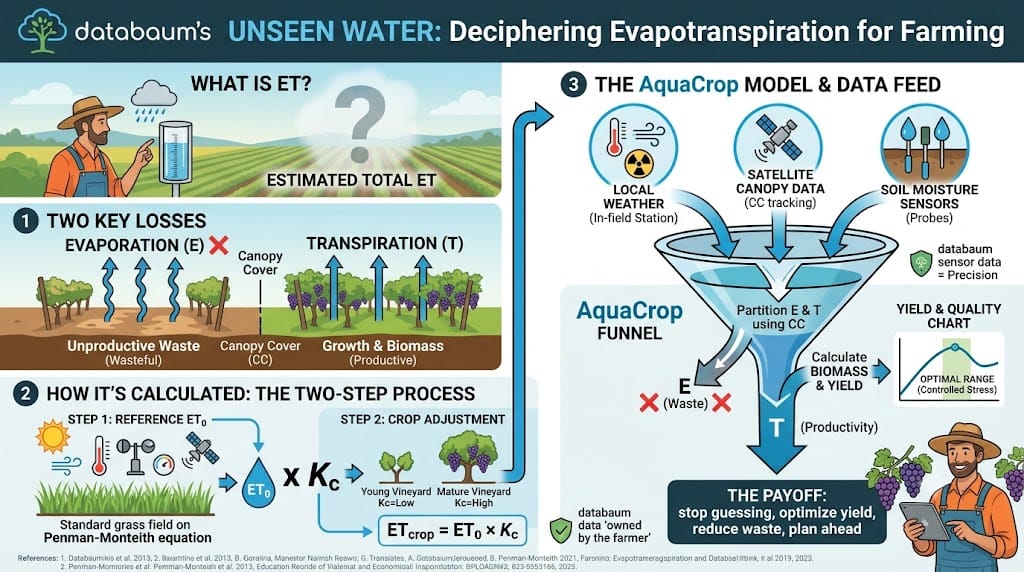
Every field loses water constantly. Some of it evaporates straight off the soil surface. The rest is pulled up through the roots, moves through the plant, and escapes as vapour through tiny pores in the leaves. Add those two together and you get evapotranspiration — usually shortened to ET — the single biggest term in a farm's water budget.
If you can measure or estimate ET well, you know almost exactly how much water your crop is using and, therefore, how much you need to replace. Get it wrong, and you either drown the crop and waste water, or you stress it and lose yield. This post walks through what ET actually is, how the AquaCrop model handles it, and why sensor data — the kind databaum works with every day — turns a rough estimate into a number you can trust.
Evaporation plus transpiration: two very different losses
It helps to keep the two halves of ET separate, because a farmer can influence each one differently.
Evaporation (E) is water leaving the bare or partly bare soil. Early in the season, when the canopy is small and a lot of soil is exposed to sun and wind, evaporation dominates. This is largely "unproductive" loss — the crop gets nothing out of it.
Transpiration (T) is water moving through the plant and out of the leaves. This loss is the price of doing business: the same open pores (stomata) that release water vapour are the ones taking in the CO₂ the plant needs to grow. Transpiration is tightly linked to yield — more transpiration, within limits, means more photosynthesis and more biomass.
So the goal of good water management isn't simply to minimise ET. It's to shift the balance away from wasteful evaporation and toward productive transpiration, and to make sure the plant never runs so short of water that it closes its stomata and stops growing.
How ET is estimated: reference ET and crop coefficients
Directly measuring ET on a real field is hard. The gold-standard instruments — weighing lysimeters, eddy-covariance flux towers, sap-flow sensors — are expensive and impractical for routine farming. So the industry standard is to estimate ET in two steps.
First, calculate a reference evapotranspiration (ET₀) — the water demand of a standard, well-watered grass surface under the current weather. The FAO Penman-Monteith equation does this using four weather inputs: temperature, humidity, wind speed, and solar radiation. ET₀ is essentially the "thirst" of the atmosphere on a given day.
Second, adjust ET₀ for your actual crop and its growth stage using a crop coefficient (Kc):
ET_crop = ET₀ × Kc
A young vineyard with sparse canopy has a low Kc; the same vineyard at full leaf has a much higher one. This two-step approach is simple, robust, and the backbone of most irrigation scheduling worldwide.
How AquaCrop handles evapotranspiration
AquaCrop is the FAO's crop water-productivity model, and it treats ET more carefully than the simple single-coefficient method above. Its defining feature is that it never lumps evaporation and transpiration together — it models them separately, because it needs transpiration specifically to drive growth.
Here is the logic in plain terms:
It starts from ET₀. Just like the standard method, AquaCrop takes daily reference ET from weather data as its measure of atmospheric demand.
It splits demand using canopy cover (CC). Instead of a single Kc, AquaCrop tracks how much of the ground the crop canopy covers over the season. The greater the canopy cover, the larger the share of water demand assigned to transpiration, and the smaller the share left for soil evaporation — because a closed canopy shades the soil and suppresses evaporation. This mirrors what actually happens in the field: early season is evaporation-heavy, peak season is transpiration-heavy.
It converts transpiration into biomass. This is the heart of AquaCrop. It uses a normalized water productivity (WP*) value — grams of biomass produced per unit of water transpired, normalised for climate. Because it's driven by transpiration rather than total ET, this relationship holds up remarkably well across different locations and years.
It throttles transpiration under water stress. When the soil dries past a crop-specific threshold, AquaCrop applies a water-stress coefficient (Ks) that reduces transpiration — and therefore growth. This is exactly the mechanism that lets AquaCrop model deficit irrigation strategies, where water is deliberately withheld at certain stages. In grapevines, for example, controlled water stress during specific phenological stages concentrates the fruit and improves wine quality, which is why growers often set their irrigation trigger below the standard comfort threshold rather than topping the soil up to full.
The output is a day-by-day water balance and a biomass/yield projection you can run under different weather and irrigation scenarios — a genuine planning tool rather than just a "how much did I lose yesterday" number.
Where databaum fits: models are only as good as their data
A model like AquaCrop is a powerful engine, but it runs on numbers. Feed it regional average weather and generic soil assumptions, and it gives you a regional average answer. Feed it your field's actual conditions, and it becomes a decision tool for your field. That gap — between a plausible estimate and a precise, field-specific one — is exactly where sensor data earns its keep, and it's the problem databaum is built around.
Precise ET rests on three data streams, and each one is a place where good sensing changes the answer:
Local weather for a real ET₀. Penman-Monteith needs temperature, humidity, wind, and radiation. A weather station on or near the field produces an ET₀ that reflects your microclimate — the frost pocket, the windy ridge, the sheltered valley slope — rather than a number borrowed from a station twenty kilometres away. databaum already builds on in-field weather station infrastructure for exactly this reason.
Canopy information from satellite. Because AquaCrop's whole partitioning of ET hinges on canopy cover, knowing how the canopy is actually developing — from satellite imagery and vegetation indices — keeps the model's evaporation-versus-transpiration split honest as the season progresses.
Soil moisture to close the loop. This is the crucial one. ET is what leaves the field; soil moisture sensors measure the consequence — how much water is actually left in the root zone right now. Multi-depth soil probes let you watch the water balance draw down in real time and check it against what the model predicted. When measurement and model disagree, the measurement wins and the model gets corrected. That feedback loop is what separates a precise ET estimate from a hopeful one.
There's a deeper point here that shapes how databaum approaches it: the data has to be yours. Sensor readings should flow directly to your own platform, not get locked inside a vendor's cloud behind a subscription. A field's water history is a long-term asset — it's what you calibrate next season's model against, and what you'd hand to an auditor or an agronomist. Data sovereignty isn't a technical nicety; it's what makes the whole exercise worth doing year after year.
What this means for the farmer, in plain terms
Strip away the equations and the payoff is simple: you stop guessing about water.
Irrigate the right amount, at the right time. Instead of watering on a fixed calendar or by feel, you water because the field's actual water balance tells you the crop is about to need it. No more topping up soil that's already wet, no more discovering stress after the damage is done.
Spend less on water and pumping. Every cubic metre you don't apply unnecessarily is water you didn't pay to pump, and in many places water you didn't pay for at all. Cutting the wasteful evaporation half of ET is largely free money.
Protect — and sometimes improve — quality. Overwatering doesn't just waste water; it invites root problems and disease, and in crops like wine grapes it dilutes exactly the qualities you're trying to concentrate. Knowing your ET precisely lets you apply controlled stress on purpose, which is a quality lever, not just a savings one.
Plan ahead instead of reacting. Because a model like AquaCrop can run forward on a weather forecast, you can see a dry spell coming and decide today whether to irrigate, rather than scrambling when the crop is already wilting.
Build a record that compounds. Every season of sensor data makes next season's predictions sharper. The field teaches the model, and the model gets better at telling you what the field needs.
Evapotranspiration is the water you never see leaving your field — but with the right mix of a solid model and real sensor data behind it, it becomes the number that quietly tells you almost everything about how to manage that field well.
Curious how precise ET and real-time soil data could work on your own fields? That's the kind of thing databaum is built for.
References
- FAO AquaCrop — https://www.fao.org/aquacrop
- databaum — https://databaum.ch