
Irrigation management for Vineyards
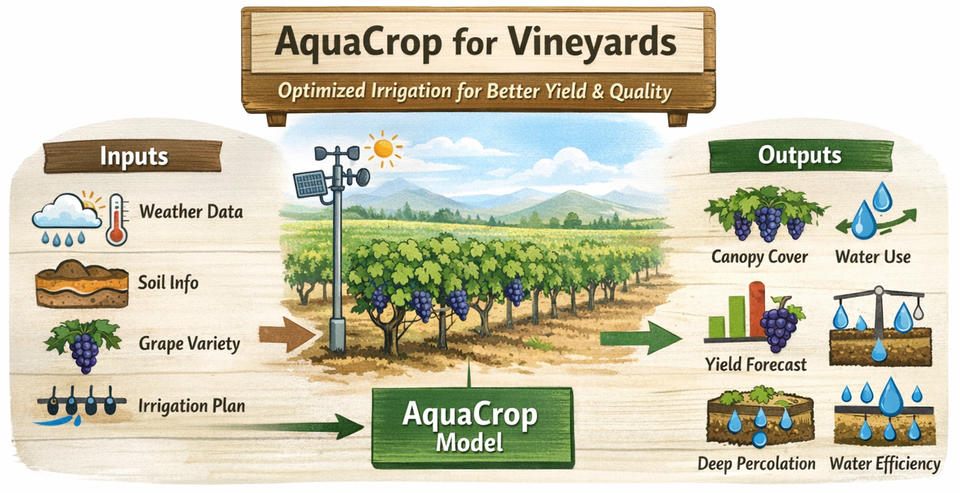
In vineyard irrigation, the question is no longer simply whether to irrigate. The real question is when, how much, and for what objective: protecting yield, preserving acidity, avoiding excessive vegetative growth, or steering berry composition toward the desired wine style. At databaum, we see AquaCrop, the FAO crop water productivity model, as a useful framework for making those decisions more systematic. AquaCrop was originally developed by FAO for herbaceous crops, so in winegrapes it should be used as an adapted and calibrated decision-support model, not as a vine-specific model out of the box. Its value is strongest where water is becoming a binding constraint and irrigation decisions need to be justified with data. [1][2] (FAOHome)
This is especially relevant in Switzerland, but also across France, Germany, Italy, Spain, and other European wine regions. Europe remains the world’s leading wine-producing region, and climate pressure is increasingly reshaping both yield and quality. Recent reviews and regional studies show that rising temperatures, more frequent drought, and stronger water stress are already influencing viticulture across traditional regions, with adaptation decisions becoming more urgent from the Upper Rhine to the Mediterranean basin. In Switzerland specifically, MeteoSwiss indicates that the country is warming faster than the global average, with drier summers, more extreme heat, and more intense heavy precipitation among the main expected changes. [3][4][5][6] (MeteoSwiss)
For databaum, the key point is simple: weather-station data is the backbone of irrigation intelligence. AquaCrop requires climate inputs such as minimum and maximum temperature, rainfall, and reference evapotranspiration (ETo), alongside soil, crop, and management data. FAO explicitly notes that these weather inputs should come from the field or from agro-meteorological stations. That makes local station data much more than a reporting layer. It becomes the basis for estimating atmospheric demand, tracking rainfall effectiveness, and understanding when a block is entering a meaningful water-stress window. Better weather data leads directly to better irrigation modelling. [2][7] (FAOHome)
This is where AquaCrop becomes useful for growers and advisors. FAO positions the model as a tool for comparing attainable and actual yields, identifying constraints to water productivity, developing irrigation schedules, and testing deficit-irrigation strategies. For a winegrower, that translates into practical outputs: root-zone water balance, crop transpiration, canopy development, likely stress periods, and the consequences of different irrigation scenarios over the season. Instead of relying on calendar irrigation or generic regional rules, a vineyard can simulate whether it is under-irrigating, over-irrigating, or simply irrigating at the wrong stage. [1][2] (FAOHome)
That matters even more across a geography as diverse as Switzerland, northern Italy, southern Germany, eastern France, and Spain. In Switzerland and the Upper Rhine, growers are dealing with more frequent summer dryness and block-level variability. In Mediterranean and semi-arid regions of Spain and Italy, irrigation is already a strategic issue for vineyard viability. Research from southern Europe shows that controlled or regulated deficit irrigation is increasingly relevant where water resources are limited, and that adaptation choices need to be locally tuned rather than copied across regions. [4][5][8] (ScienceDirect)
From the databaum side, the opportunity is not to tell growers to “use more water” or “use less water.” The opportunity is to help them optimize irrigation around quality, yield, and water productivity at the same time. That means connecting four things:
- local weather-station data
- vineyard soil and block data
- irrigation records and strategy options
- the grower’s production target, including wine style and fruit quality
When those pieces are connected, AquaCrop can support decisions such as when to hold a block near comfort, when to allow mild stress, and when a heat event or dry spell requires intervention. [1][2] (FAOHome)
Can optimized irrigation also improve grape and wine quality?
In winegrapes, irrigation is not just a water-management issue. It is a quality-management issue. A large part of the viticulture literature shows that mild to moderate, well-timed deficit irrigation can help manage berry composition and wine style, while excessive irrigation can dilute quality and severe stress can damage it. The practical goal is not maximum water supply. The goal is the right deficit at the right stage. [9][10][11] (MDPI)
This is especially relevant for premium wine regions. Studies have shown that regulated deficit irrigation can influence anthocyanins, tannins, phenolics, antioxidant capacity, and sensory outcomes, depending on timing and severity. For example, work on Cabernet Sauvignon found that some deficit strategies increased skin anthocyanins and seed tannins, while a recent study reported that stage-specific irrigation strategies could increase phenolic content and antioxidant capacity while conserving water, though with trade-offs in berry organic acids. In other words: irrigation optimization can support better fruit and wine quality, but only when it is precisely timed and carefully controlled. [9][10][11] (MDPI)
That is why databaum’s perspective is to frame irrigation not as a single prescription, but as a decision layer. A grower should be able to ask:
Should this block be protected before veraison?
Can we allow moderate deficit after canopy establishment?
Are we drifting into stress that will hurt acidity or berry balance?
Did last week’s weather materially change the next irrigation decision?
These are the questions where station-grade weather data, vineyard context, and a model like AquaCrop can create real value. [1][2][9] (FAOHome)
The databaum view
For databaum, AquaCrop is not just a model. It is part of a practical infrastructure for site-specific vineyard irrigation. In Switzerland and nearby countries, and increasingly across Italy, Spain, France, and Germany, the most valuable irrigation systems will be the ones that combine local weather data, soil-aware water balance, and quality-oriented production goals. The future of winegrape irrigation is not about maximizing water. It is about optimizing water — for resilience, for efficiency, and for grape and wine quality. [3][4][6][8]
References
[1] FAO. AquaCrop – The FAO Crop Water Productivity Model. Official AquaCrop overview and software page. (FAOHome)
[2] FAO. About AquaCrop and Input Requirements. FAO overview of AquaCrop applications, irrigation use cases, and required weather, soil, crop, and management inputs. (FAOHome)
[3] MeteoSwiss. Climate change and Swiss climate scenarios. Official Swiss climate outlook highlighting more extreme heat, drier summers, and heavier precipitation. (MeteoSwiss)
[4] Bohnert, G. & Martin, B. (2023). Impacts of climate change induced drought and adaptation strategies in wine-growing in the Rhine Valley (France, Germany, Switzerland). (ScienceDirect)
[5] Fraga, H. et al. (2021). Future Climate Change Impacts on European Viticulture: A Review on Recent Scientific Advances. Review covering European viticulture, including major wine-producing countries such as Italy, France, and Spain. (MDPI)
[6] Nature Reviews Earth & Environment (2024). Climate change impacts and adaptations of wine production. Review discussing climate impacts on wine production across major European wine regions. (Nature)
[7] MeteoSwiss. Swiss climate scenarios. Official explanation of nationally available climate data and scenario products for adaptation planning. (MeteoSwiss)
[8] Gómez et al. (2023). Sustainability of Vine Cultivation in Arid Areas of Southeastern Spain through Strategies Combining Controlled Deficit Irrigation and Selection of Monastrell Clones. Evidence that controlled deficit irrigation can support sustainability in semi-arid wine regions with limited water resources. (MDPI)
[9] Casassa, L.F., Keller, M., & Harbertson, J.F. (2015). Regulated Deficit Irrigation Alters Anthocyanins, Tannins and Sensory Properties of Cabernet Sauvignon Grapes and Wines. (MDPI)
[10] Candela et al. (2021). Effects of Water Deficit Irrigation on Phenolic Composition and Antioxidant Activity of Monastrell Grapes under Semiarid Conditions. (MDPI)
[11] Effects of regulated deficit irrigation at different times on organic acids, phenolics and antioxidant capacity of Cabernet Sauvignon grapes (2025). Recent evidence that appropriately timed irrigation strategies can improve phenolics and antioxidant capacity while conserving water, with trade-offs in organic acids. (ScienceDirect)