
How Disease Prediction and BBCH Prediction Work Together in the Vineyard
In vineyard protection, timing matters as much as the product you choose. A day with high infection pressure does not mean the same thing before flowering, during a sensitive development stage, or later in the season. That is why databaum combines two types of prediction: disease prediction and BBCH prediction.
Disease prediction helps answer a weather and infection question: when are conditions favorable for infection, how fast is incubation progressing, and when could symptoms become visible? BBCH prediction answers a plant-development question: what stage is the vine most likely to be in on that same day?
Used together, these predictions give growers a more practical decision tool. Instead of seeing only "risk" or only "growth stage," they can judge the urgency of action in the context of the crop itself.
How to read the disease prediction
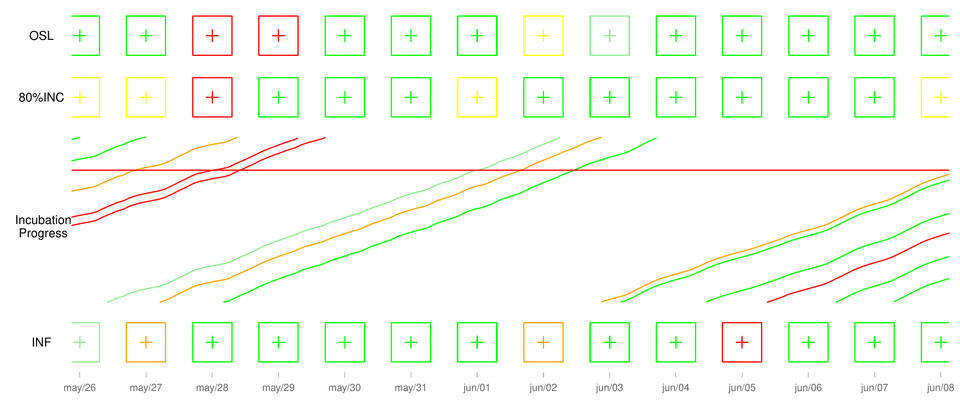
The disease view is designed to make infection timing easier to interpret over a period of days.
INFindicates predicted infection pressure for a given day.80%INChighlights infections that are approaching a late incubation stage that many growers monitor closely.OSLmarks the expected timing of visible oil spot appearance if the infection develops under favorable conditions.
The color progression makes the signal easier to scan quickly. Green means lower concern. Yellow and orange call for more attention. Red indicates the highest concern in the displayed period.
The incubation progress lines in the middle are important because they connect one moment to another. They show that a risky infection day does not end on that day. An infection can begin under favorable weather, continue to develop during incubation, and only later become visible in the field. In other words, the graph is not only about "what happened today." It is also about what that event may lead to a few days later.
For growers, that matters because better timing often depends on understanding this sequence:
infection -> incubation progress -> visible symptoms
When this progression is displayed clearly, it becomes easier to decide when to scout, when to increase attention, and when a treatment window may be more urgent.
What the BBCH prediction adds
Disease pressure is only half of the story. The other half is the vine itself.
BBCH prediction estimates the likely phenological stage of the vine for each day. It is not a promise that the plant will be in one exact stage on one exact date. Instead, the model gives the most likely stage and, when uncertainty is higher, a range of nearby plausible stages.
This is useful because the same disease risk can mean different things at different moments of vine development. A risky weather window during a less sensitive stage is not interpreted the same way as a risky window during flowering or another vulnerable period.
The BBCH output should therefore be read as decision support, not as absolute ground truth. When the predicted range is narrow, the system is relatively confident. When the range is wider, the model is signaling uncertainty and a field check becomes more valuable.
One of the strongest parts of the BBCH workflow is that grower observations improve the next prediction. If a grower or agronomist records the currently observed stage, future predictions become more precise and biologically more consistent. In practice, AI and field observation work better together than either one alone.
Why these two predictions are stronger together
A disease alert on its own answers one question:
"Were conditions favorable for infection?"
A BBCH prediction on its own answers another:
"What stage is the vine likely to be in?"
But growers do not manage vineyards using isolated questions. The real operational question is:
"How urgent is this risk for this field, in this stage, right now?"
That is where the value of combining disease prediction with BBCH prediction becomes clear.
- If infection pressure rises while the vine is likely to be in a sensitive stage, the need for scouting or protection becomes more urgent.
- If disease pressure is moderate but the BBCH range is wide, a quick field inspection may be the best next step.
- If the grower confirms the actual stage, the next BBCH prediction becomes tighter and the disease interpretation becomes more useful.
This combined view supports more efficient timing. It helps growers avoid acting too late, but it also helps avoid treating blindly without considering actual crop development.
A practical grower workflow
One simple way to use these tools in practice is:
- Check the weekly disease view and identify days with rising infection pressure.
- Look at the incubation progression to understand whether recent infections are moving toward symptom appearance.
- Compare those days with the predicted BBCH stage for the same period.
- Inspect the field if the disease signal is strong or the BBCH range is wide.
- Record the observed BBCH stage when possible so that the next prediction becomes more specific.
This workflow turns the platform into more than a warning system. It becomes a planning tool for scouting and treatment timing.
Better predictions start with better field feedback
Grower feedback is not just helpful for record keeping. It improves the quality of the prediction itself.
When observations are entered regularly, even when the field is healthy, the system has a better reference for interpreting plant development and disease progression. That means the output becomes more useful over time.
This is an important product idea to keep in mind: the platform is not meant to replace field knowledge. It is meant to make field knowledge more actionable.
Conclusion
In viticulture, good timing depends on understanding both hazard and vulnerability.
Disease prediction shows when infection pressure is building and how it may progress. BBCH prediction shows where the vine is likely to be in its development when that pressure arrives. Read together, these tools help growers make more informed, timely, and field-specific decisions.
That is the real value of combining disease prediction with BBCH prediction: not more data for its own sake, but clearer action at the right moment.
Disclaimer: This article is for educational and product-explainer purposes only. Always consider local regulations, label instructions, and the advice of a qualified agronomic professional before applying plant protection products.